
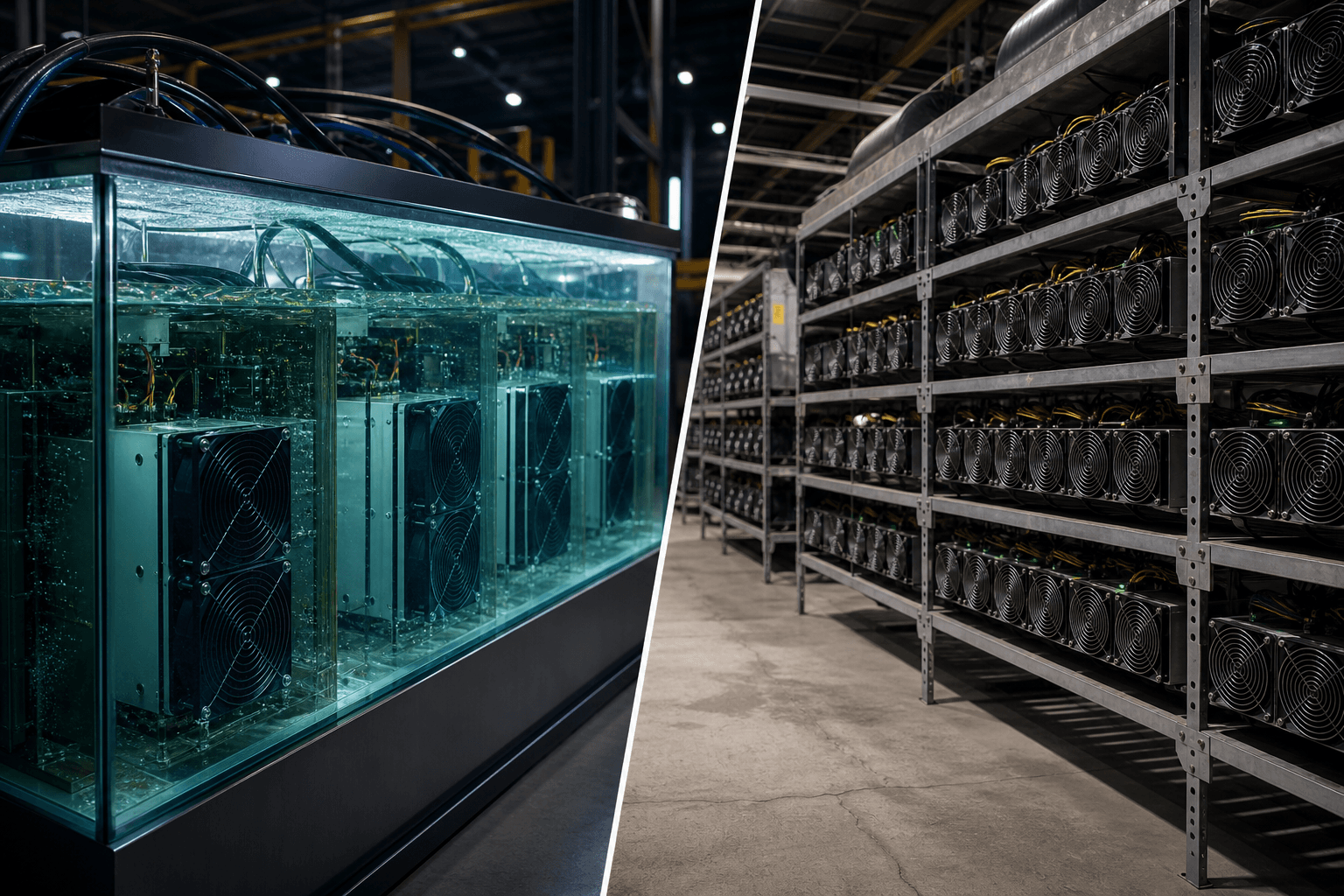
Immersion Cooling ROI vs Air Cooling: What the Slide Deck Leaves Out
A downside-aware way to compare immersion and air cooling that actually prices in fluid maintenance, pump failures, and scaling friction.
We got a quote for a six-tank immersion setup last year that ran almost triple the equivalent air-cooled room in racking and fans. The efficiency numbers on the immersion side looked great on the vendor's slide. What wasn't on the slide: fluid top-offs, gasket replacements, and the two extra hours a week someone spends checking dielectric fluid levels. ROI math that skips that part isn't wrong, it's just incomplete.
The real decision isn't efficiency vs efficiency
Immersion cooling genuinely lets you run hotter chips harder and often extends hardware life by keeping junction temps lower and more stable. That part is real. Where operators get burned is comparing immersion's efficiency gains against air cooling's simplicity without pricing the full lifecycle on both sides.
What actually needs to go in the model
- Capex: tanks, dielectric fluid (which isn't cheap and needs occasional replacement), pumps, heat exchangers, and controls — measured against air cooling's simpler racking, fans, and ducting.
- Opex: fluid top-offs, filter changes, and the maintenance labor of pulling a board out of fluid versus pulling it off a rack. Immersion repairs take longer and are messier every time.
- Uptime: what happens when a pump fails at 2am versus what happens when a fan fails at 2am. Air-cooled fan swaps are a five-minute fix with parts you probably already have on the shelf.
- Scaling friction: adding ten more air-cooled units is mostly a rack and a PDU. Adding ten more immersion units usually means more tank capacity and fluid volume, which is a bigger, slower purchase.
A note on temperature and warranty
Dielectric fluid runs miners at bath temperatures that are often noticeably lower than typical air-cooled intake temps, which is exactly why boards can handle a harder overclock without throttling. But check your warranty terms before you dunk anything — some ASIC manufacturers void hardware warranty on immersion, others require you to use their approved fluid brand, and finding that out after the tanks are full is a bad way to learn it.
Run it as a scenario, not a single number
- Build a base case with realistic — not vendor-optimistic — maintenance hours and a fluid replacement schedule.
- Build a downside case: higher maintenance frequency, a pump failure or two, lower realized uptime than the spec sheet promises.
- Stress the downside case against a harder network — higher difficulty, softer BTC price — since cooling choice matters a lot more when margins are thin.
- Pick whichever setup survives the downside case, not whichever wins the best-case slide.
If your model skips maintenance complexity and recovery time, the ROI number you land on is almost always too optimistic.
Where each one actually wins
Immersion tends to make sense at scale, in hot climates, or when you're running chips harder than their air-cooled spec and need the thermal headroom to do it safely. Air cooling tends to win for smaller fleets, cooler climates, or anyone who'd rather do a five-minute fan swap than a fluid-handling procedure when something breaks at 2am.
Honest caveat: we've seen immersion setups with worse effective uptime than air-cooled setups in the same building, purely because nobody budgeted for pump redundancy or trained staff on fluid handling. The cooling method isn't what determines your uptime — the maintenance plan behind it is. Run both scenarios through our profitability calculator with your actual power rate and hardware mix before committing capex either direction; a 30-40% swing in maintenance assumptions is usually enough to flip which option wins.
Tags
Author & editorial standards
Written by Admin. Content is reviewed under our editorial policy for accuracy, operational clarity, and transparent sourcing on mining economics and hardware.
Continue This Topic
Mining Playbooks
Execution-focused frameworks for miner selection, hosting, and scaling decisions.
Trust Center
Transparency, support standards, and platform reliability principles.
Profitability Calculator
Model downside risk and break-even scenarios with current assumptions.
Firmware Library
Find tested firmware resources and maintenance references.
Related Posts
Curtailment and Demand Response for Bitcoin Mining: A Practical Operator Guide
Grid curtailment and demand-response programs can lower your effective kWh rate—or wreck uptime if you sign blind. Here is how hosted and self-operated farms should read the fine print.
Cloud Mining vs Buying an ASIC: Honest Comparison for Bitcoin Exposure
Compare USDT cloud fixed-reward contracts against buying Bitcoin ASICs—upfront cost, ops burden, payout predictability, and when each path actually makes sense.
Rent Hashrate When You Need Proof-of-Work Now, Not After Freight Clears
Short-term Bitcoin hashrate aimed at your pool URL—solo experiments, failover drills, or a timed boost—without buying another pallet of rigs.