
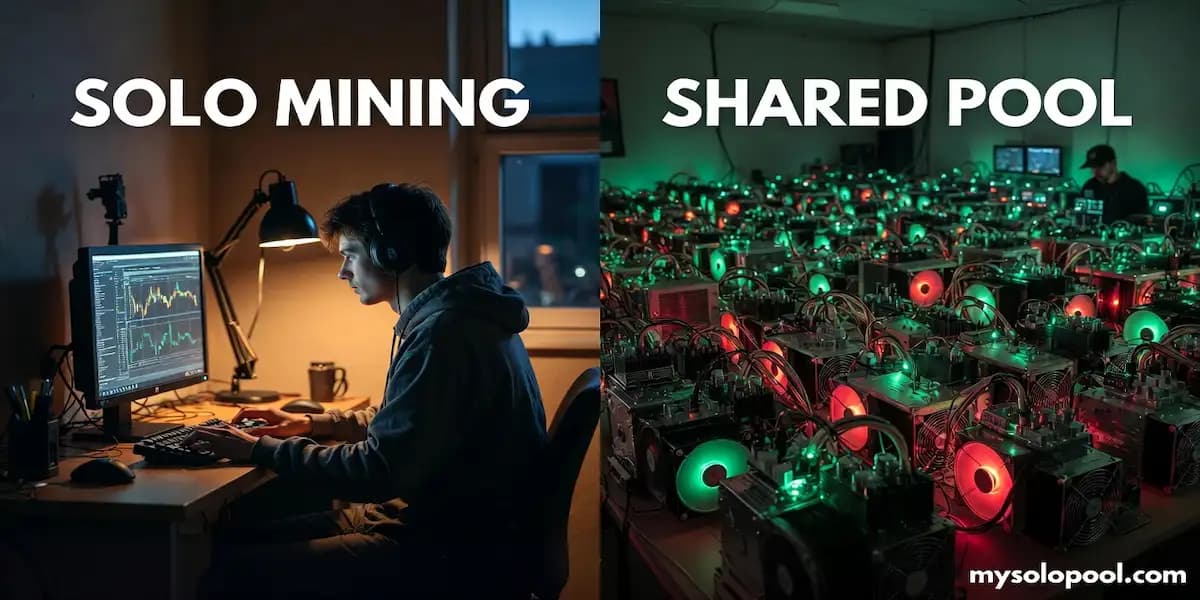
Mining Pools vs Solo Mining: Share Payouts vs Full 3BTC Block Reward
Compare traditional mining pool share payouts with solo mining for the full 3+ BTC block reward. Learn which strategy fits your operation, the hidden cost of pool fees, and how MySoloPool.com makes solo mining accessible.
Every Bitcoin miner faces a fundamental choice: join a mining pool and receive small, steady share-based payouts, or mine solo and aim for the full block reward of 3.125 BTC (worth over $300,000 at current prices). Both approaches have clear trade-offs in reward size, variance, fees, and control. This guide breaks down exactly how each model works, who each one is best for, and why advanced solo miners are turning to platforms like MySoloPool.com to chase full block rewards without giving up professional infrastructure.
Whether you run a single ASIC at home or operate a fleet of machines, understanding the difference between shared pool payouts and solo block rewards is essential to choosing the strategy that matches your goals, risk tolerance, and hash rate.
How Traditional Mining Pools Work: Share-Based Payouts
A mining pool combines hash power from thousands of miners into a single operation. When the pool finds a block, the 3.125 BTC reward is split among all participants based on the number of valid shares each miner submitted. A share is proof that your machine did real work toward finding the block—even though most shares don't actually solve the block, they prove you were contributing.
Think of it like a lottery syndicate: everyone buys tickets together, and when the group wins, the prize is divided proportionally. You win more often, but each win is smaller.
Common Pool Payout Methods
- PPS (Pay Per Share): You get paid a fixed amount for every valid share, regardless of whether the pool finds a block. The pool absorbs the variance risk. Fees are typically higher (2–4%) to compensate.
- FPPS (Full Pay Per Share): Like PPS but also includes an estimated share of transaction fees from each block. This is the most common method on major pools today.
- PPLNS (Pay Per Last N Shares): Rewards are distributed based on your share contribution in a recent window of shares. This rewards loyal, consistent miners and discourages pool-hopping. Fees are lower (1–2%) but payouts vary more.
- PROP (Proportional): When a block is found, the reward is split proportionally among all shares submitted during that round. Simple, but round length varies widely.
What You Actually Receive in a Pool
Let's say a pool with 10 EH/s total hash rate finds a block worth 3.125 BTC + 0.3 BTC in transaction fees = 3.425 BTC total. If you contribute 100 TH/s, your share of the pool is 100 TH/s ÷ 10,000,000 TH/s = 0.00001 (0.001%). Your payout for that block: approximately 0.00003425 BTC (~$3.30 at $97,000/BTC).
Across ~144 blocks per day, the pool may find 5–15 blocks (depending on its size relative to the network). Your daily earnings accumulate from these small slices. After pool fees (1–3%), you receive a predictable, steady stream of satoshis—small amounts, but consistent.
How Solo Mining Works: The Full Block Reward
Solo mining means your machines work independently to solve a block. There's no splitting. If your miner finds a valid block, you receive the entire block reward—3.125 BTC plus all transaction fees—which often totals over 3 BTC in a single payout. At today's prices, that's a lump sum of $300,000 or more, sent directly to your wallet.
The trade-off is straightforward: the probability of finding a block is directly proportional to your share of the global hash rate. With a single S21 running at 200 TH/s against a network of ~700 EH/s, your odds of finding a block on any given day are roughly 1 in 3,500,000. That means you could mine for years—or decades—without finding a block. Or you could find one tomorrow.
Solo mining is high-variance by nature. But when it hits, the reward is life-changing—and there's no pool fee taking 1–3% off the top.
Key fact: In 2024 and 2025, individual solo miners with as little as 1–5 PH/s have found full Bitcoin blocks, taking home the entire 3+ BTC reward. These events, while rare, are real and well-documented on the blockchain.
Pool Mining vs Solo Mining: Side-by-Side Comparison
| Factor | Pool Mining (Share Payout) | Solo Mining (Full Block Reward) |
|---|---|---|
| Reward per block | Tiny fraction (proportional to your hash rate share of the pool) | Full 3.125 BTC + transaction fees (~3+ BTC total) |
| Payout frequency | Daily or more often (steady drip) | Only when you find a block (could be days, months, or years) |
| Variance | Low—predictable income | Very high—feast or famine |
| Fees | 1–4% pool fee on every payout | 0% or minimal fee (on solo pool platforms) |
| Control | Pool chooses block template and transaction selection | You (or your solo pool) control block construction |
| Ideal for | Miners who need predictable cash flow to cover electricity and hosting | Miners with enough capital to absorb variance and bet on full rewards |
| Expected long-term earnings | Slightly less (due to pool fees) | Slightly more (no fee taken from your block reward) |
The Math: What 3+ BTC Really Means
After the April 2024 halving, each Bitcoin block pays 3.125 BTC in subsidy. On top of that, transaction fees vary but commonly add 0.1–0.5 BTC per block, and during high-fee periods (ordinals, runes, mempool congestion), fees can spike to 1 BTC or more. That puts the total block reward regularly above 3 BTC.
At a Bitcoin price of $97,000, a single block reward of 3.2 BTC equals $310,400. In a pool, that same block gets sliced among thousands of miners—your cut might be $3–$50 depending on hash rate. Solo, the full amount lands in your wallet.
For perspective, if you run 1 PH/s (1,000 TH/s) against a 700 EH/s network, your expected time to find a block is roughly 48 days. With 5 PH/s, it drops to about 10 days. With 500 TH/s, you're looking at roughly 96 days on average—but averages don't mean guarantees. That's why solo miners need both patience and financial runway.
MySoloPool.com: An Advanced Solo Mining Pool
Running a solo mining operation doesn't mean you have to run your own Bitcoin node, manage Stratum server software, and handle block template construction yourself. That's where MySoloPool.com comes in—a purpose-built advanced solo mining pool designed for miners who want the full block reward without the infrastructure headache.
Here's what makes MySoloPool different from traditional pools:
- Full block reward: When your miner finds a block, you get the entire 3+ BTC. No splitting, no proportional shares—the whole reward goes to you.
- Professional Stratum infrastructure: MySoloPool handles the Stratum server, node management, and block template construction. You just point your ASIC and mine.
- Real-time monitoring: Track your hash rate, shares, and estimated time-to-block through an advanced dashboard. Know exactly how your machines are performing at all times.
- Low or zero fees: Unlike traditional pools that take 1–4% of every payout, solo pools like MySoloPool charge minimal fees—keeping more Bitcoin in your wallet when you hit a block.
- Multiple coin support: Beyond Bitcoin, MySoloPool supports solo mining for other SHA-256 and proof-of-work coins, giving you flexibility to mine what's most profitable.
- Easy setup: Point your miner to MySoloPool's Stratum address, enter your wallet, and start mining solo. No need to run your own full node or configure complex software.
For miners with significant hash rate who believe in the upside of full block rewards, MySoloPool.com provides the infrastructure so you can focus on mining—not on sysadmin work.
Who Should Mine in a Pool vs Solo?
Pool mining makes sense when:
- You need predictable cash flow to cover electricity, hosting, or loan payments every month.
- You have a small operation (1–10 machines) and finding a solo block could take years.
- You prefer low variance and don't want to risk long stretches with zero income.
- You're new to mining and want a simple, set-and-forget experience with regular payouts.
Solo mining makes sense when:
- You have enough hash rate (typically 500 TH/s or more) to have a reasonable expected time-to-block.
- You can afford the electricity during dry spells without relying on daily BTC income.
- You want to avoid pool fees and keep 100% of the block reward when you hit.
- You want more control over your mining operation and block construction.
- You view mining as a long-term bet and have the patience and capital to ride out the variance.
Many experienced miners actually run a hybrid strategy: most of their hash rate goes to a pool for steady income, while a portion is pointed at a solo pool like MySoloPool.com as a "lottery ticket" that could pay out 3+ BTC at any time.
The Hidden Cost of Pool Fees Over Time
Pool fees look small—1% or 2%—but they compound significantly over months and years. Here's what a 2% pool fee costs a miner earning 0.01 BTC/day over different time horizons:
| Time Period | BTC Earned (Gross) | 2% Fee Paid | Fee in USD (at $97k) |
|---|---|---|---|
| 1 Month | 0.30 BTC | 0.006 BTC | $582 |
| 6 Months | 1.80 BTC | 0.036 BTC | $3,492 |
| 1 Year | 3.65 BTC | 0.073 BTC | $7,081 |
| 2 Years | 7.30 BTC | 0.146 BTC | $14,162 |
Over two years, a 2% pool fee costs this miner 0.146 BTC—over $14,000. Solo miners who find blocks keep every satoshi. That's the economic argument for solo mining: if you can handle the variance, you keep more of what you earn.
Pro Tips for Solo Miners
- Use a dedicated solo pool like MySoloPool.com. Running your own node and Stratum server introduces failure points. A professional solo pool handles infrastructure while you keep the full reward.
- Calculate your expected time-to-block honestly. At 1 PH/s against 700 EH/s, you're looking at ~48 days on average. Make sure you can cover electricity costs for 2–3x that period with zero BTC income.
- Monitor your hash rate religiously. Every hour of downtime reduces your probability of finding a block. Use your solo pool's dashboard to catch issues early.
- Consider the hybrid approach. Put 70–80% of your hash rate on a traditional pool for steady income, and dedicate 20–30% to solo mining for the chance at a full block reward.
- Don't give up too early. Probability is not a guarantee—you might go 2x or 3x the expected time without a block. That's normal variance, not bad luck. The math works out over time.
- Watch transaction fee trends. During high-fee environments (inscriptions, token mints, network congestion), block rewards can spike well above 3.125 BTC. A solo-mined block during a fee spike is exceptionally profitable.
Real-World Solo Mining Success Stories
Solo mining isn't just theoretical. Across 2024 and 2025, multiple solo miners have found full Bitcoin blocks with modest hash rates:
- A solo miner with approximately 3 PH/s found a block and received the full 3.125+ BTC reward—worth over $200,000 at the time.
- Multiple blocks have been mined by solo operators running through solo pool services, proving that the model works for miners who can handle the variance.
- During ordinals-driven fee spikes, some solo-mined blocks paid out over 4 BTC total when transaction fees surged.
These aren't fairy tales—they're on-chain, verifiable events. Each one represents a miner who chose solo over pool and was rewarded with the full prize.
Getting Started with Solo Mining on MySoloPool.com
Setting up solo mining through MySoloPool.com is straightforward:
- Visit mysolopool.com and select Bitcoin (or your preferred coin).
- Get the Stratum connection details—server address and port—from the pool's getting-started page.
- Configure your ASIC miner: Enter the Stratum URL, your Bitcoin wallet address as the username, and any password (commonly "x").
- Start mining. Your miner will begin submitting shares to MySoloPool's Stratum server. Each valid share is a chance at solving the next block.
- Monitor your dashboard. Track your real-time hash rate, shares submitted, and estimated time-to-block. When your miner finds a block, the full 3+ BTC reward is sent to your wallet.
No node setup, no server management, no complex configuration. Just plug in, point, and mine for the full block reward.
Common Mistakes to Avoid
- Solo mining without enough runway. If you can't cover 3–6 months of electricity without BTC income, solo mining is too risky. Use a pool for stability first.
- Ignoring transaction fees in your calculations. Block rewards are 3.125 BTC subsidy PLUS transaction fees. When comparing pool vs solo economics, include the fee component—some pools keep a larger share of fees than you realize.
- Running your own node without expertise. A misconfigured node means missed blocks. Use a professional solo pool like MySoloPool.com instead of risking infrastructure failures.
- Pool-hopping based on short-term luck. Moving between pools or switching solo/pool frequently based on a bad week wastes time and can cost you shares during transition periods.
- Underestimating variance. "Expected time to block" is an average. You might find one in a day or wait 5x the average. Plan for the long tail, not the average.
Warning: Solo mining with very low hash rate (under 100 TH/s) is essentially a lottery ticket. The expected time to find a block could be measured in years or decades. Only allocate hash rate to solo mining that you're comfortable running at zero return for an extended period.
Conclusion
The choice between pool mining and solo mining comes down to your hash rate, financial runway, and appetite for variance. Pools give you steady, predictable payouts at the cost of fees and smaller rewards. Solo mining gives you the shot at the full 3+ BTC block reward—over $300,000 per block—but requires patience, capital, and the right infrastructure.
For miners ready to go solo, MySoloPool.com offers the advanced infrastructure needed to mine independently without the complexity of running your own node and Stratum server. Point your ASICs, monitor your dashboard, and mine for the full block reward.
Whether you choose pool, solo, or a hybrid of both—the most important thing is understanding the math, managing your costs, and choosing the model that fits your operation. If you need help with hosting, hardware, or setting up your mining strategy, Hashrate.farm is here to help.
Tags
Author & editorial standards
Written by Admin. Content is reviewed under our editorial policy for accuracy, operational clarity, and transparent sourcing on mining economics and hardware.
Continue This Topic
Mining Playbooks
Execution-focused frameworks for miner selection, hosting, and scaling decisions.
Trust Center
Transparency, support standards, and platform reliability principles.
Profitability Calculator
Model downside risk and break-even scenarios with current assumptions.
Hosting Options
Compare managed hosting trade-offs and infrastructure fit.
Related Posts
MySoloPool's First LTC+DOGE Solo Block Is On-Chain
On 13 August 2026 our Scrypt solo pool solved Litecoin 3,159,431 and Dogecoin 6,330,706 in the same second. Here's the coinbase split, the explorer links, and where to point an L7 or L9.
MySoloPool Multi-Coin Solo Pools: BTC, BCH, LTC+DOGE, and ZEC Under One Brand
MySoloPool runs solo lottery stratum for Bitcoin, Bitcoin Cash, merged Litecoin+Dogecoin, and Zcash. One philosophy: wallet-as-username, fee on block find, live dashboards—pick your algorithm.
Zcash Solo Mining on MySoloPool: Equihash Setup for Z15 and GPU Rigs
Point Equihash miners at zec.mysolopool.com with your ZEC address as worker. Vardiff on :3330, NiceHash rentals on :3331, 3% fee on block find, live stats at zcash.mysolopool.com.