
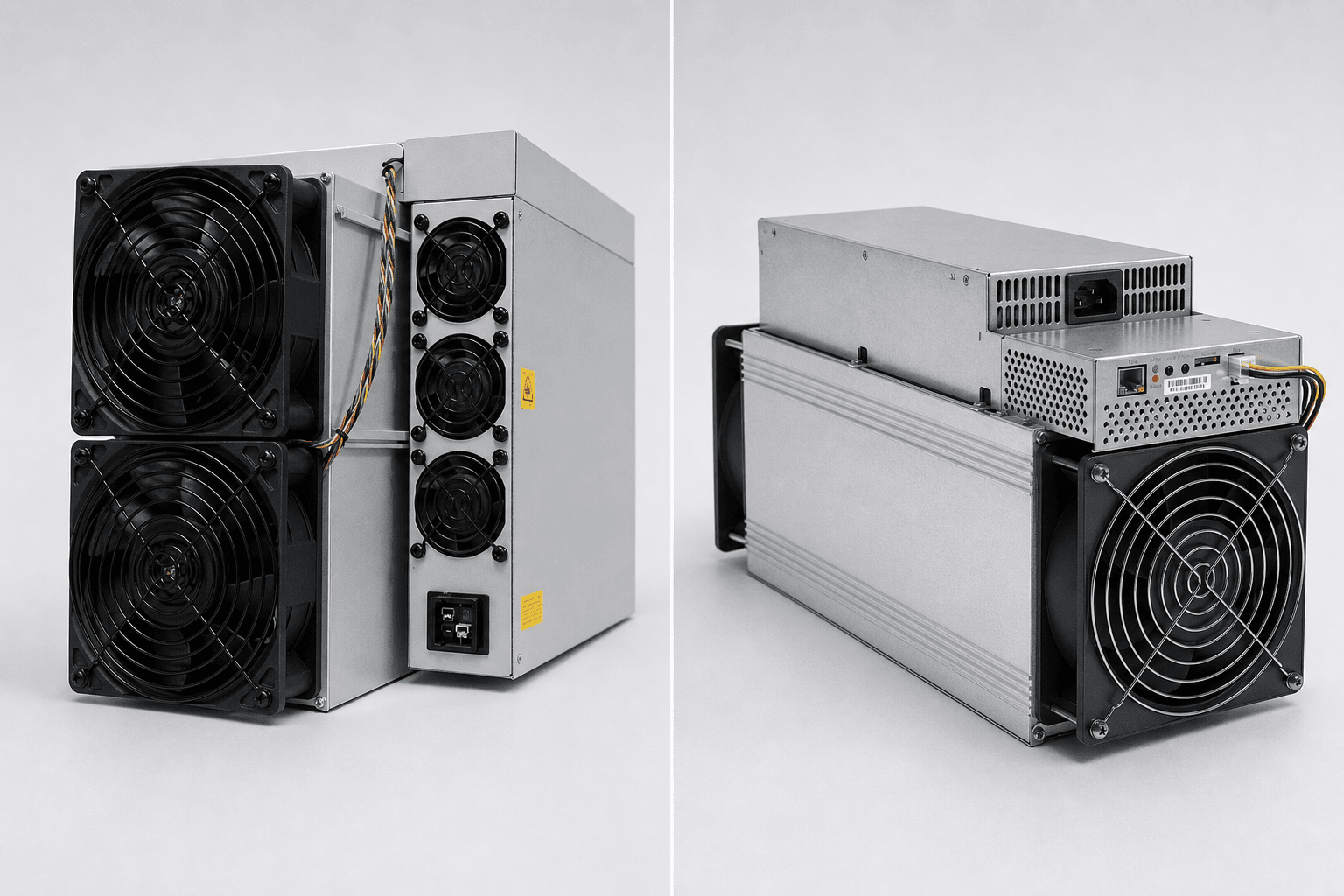
Antminer S21 vs Whatsminer M60: Price, Power, and Reliability Compared
Same TH/s shopping list, different story on sticker price, watts per terahash, and how often hash boards and PSUs come back dead—we break down S21 vs M60 honestly.
You're comparing two flagships, not two bargains
If you're down to the Antminer S21 and the Whatsminer M60, you're already shopping the top shelf of air-cooled SHA-256. Both machines can mine Bitcoin seriously. The fork in the road is whether you want to pay a premium for efficiency on paper—or pay less upfront and accept a hungrier, heavier box that many farms swear stays online longer.
As of early July 2026, Bitcoin is trading around $61,400 with network hashrate near 955 EH/s and the next difficulty adjustment tracking slightly down (~1%). That context matters: when margins are tight, watts per terahash and RMA days off rack hurt more than a brochure spec.
Spec sheet at a glance
| Factor | Antminer S21 (typical) | Whatsminer M60 (typical) |
|---|---|---|
| Hashrate | ~200 TH/s | ~186 TH/s |
| Wall power | ~3,500 W | ~3,441 W |
| Efficiency | ~17.5 J/TH | ~18.5 J/TH |
| Cooling | Air | Air |
| Typical warranty | ~180 days (vendor) | ~365 days (vendor) |
On raw wattage the boxes look close. The gap shows up when you normalize: the S21 squeezes more terahashes out of each kilowatt-hour. The M60 trades a few joules per terahash for a chassis and supply chain that many operators describe as more forgiving when the farm isn't perfect.
Sticker price: S21 usually costs more for the same terahash
In the real market—not the launch slide deck—an S21 often lands higher per TH/s than an M60 at similar output bands. Bitmain's top bin commands a premium; MicroBT frequently undercuts on secondary listings and bulk quotes when you line up ~180–200 TH/s class machines.
Example framing we see weekly: two quotes at roughly the same terahash tier, and the S21 line item is commonly $300–$800+ above a comparable M60, before shipping and hosting deposit. Exact numbers swing with BTC price and inventory—run your quote, don't trust a blog table—but the pattern holds: you're paying for Bitmain's efficiency lead and brand liquidity, not just silicon.
Normalize every quote to $/TH/s and $/kW hosted. A cheaper machine that draws more watts per terahash can lose the fight at $0.08/kWh even if it wins on capex.
Power: M60 uses more energy per terahash
Total wall draw on the nameplate is nearly a tie (~3.4–3.5 kW). What bites is efficiency: at ~18.5 J/TH the M60 needs more power than the S21 (~17.5 J/TH) to deliver the same hashrate. Over a year that gap compounds—especially if you're on residential or mid-tier industrial rates.
Rough day math at manufacturer ratings: S21 around 84 kWh/day at 200 TH/s; M60 around 82–83 kWh/day at ~186 TH/s—but you're buying fewer terahashes on the M60 side, so cost per TH/s is higher on power for MicroBT in most scenarios. If your hosting quote is all-in per kW, ask the provider to model both units at your actual voltage and uptime—not showroom 25°C.
Stress both rigs in our profitability calculator with your kWh rate and a conservative downtime assumption before you wire money.
Reliability: M60 stability vs S21 defect headaches
This is where forum war stories and our repair bench overlap. The S21 family pushes efficiency hard; when everything is clean power, cool intake, and stable firmware, it's a beast. When the environment is messy—dust, voltage sag, summer heat—we see more hash board and PSU returns on S21-class rigs relative to M60 fleets of similar age.
Common S21 failure modes we handle in repair intake:
- Hash board drops — one chain flatlines while others hash; often heat or VRM stress.
- PSU failures — APW-class supplies taking down the whole worker after a brownout.
- Intermittent reboot loops — firmware + power interaction when the rack isn't delivering what the spec sheet assumes.
M60 operators frequently report lower defect rates and calmer uptime in harsh or remote sites—think dusty intake, less-than-perfect PDUs, operators who can't swap a board same-day. MicroBT's longer factory warranty (often ~12 months vs ~6 on S21, vendor-dependent) matches that positioning. It's not magic; M60s still fail. But the failure curve many farms see is gentler, and that's cash flow when you're solo or on a thin pool margin.
Any model can brick. Budget spare PSUs, keep hash boards in warranty pipeline, and don't run without professional hosting or monitoring if you can't touch the machine within hours.
Who should buy which?
Lean S21 if…
- Your all-in power is above ~$0.07/kWh and you can keep intake temps and PDUs clean.
- You want the efficiency edge and accept higher capex per TH/s.
- You have fast RMA logistics or on-site techs who've done Bitmain boards before.
Lean M60 if…
- You want lower upfront $/TH/s and can absorb slightly higher watts per terahash.
- Uptime matters more than winning a spec sheet—remote sites, dusty rows, smaller ops without a bench tech.
- You've already standardized on Whatsminer tooling (WhatsMiner Tool, Farm Manager scans).
Neither belongs in a bedroom. Both are ~75 dB industrial heaters. Plan rack space, airflow, and noise like an adult.
Hosting and buying through Hashrate Farm
We sell and host both ecosystems. Browse buy miners for current S21 and Whatsminer listings with optional colocation on hosting pages—electricity and maintenance bundled on eligible SKUs. If you're importing used units, our ASIC repair team sees the failure patterns above daily; we'd rather steer you pre-purchase than surprise you post-freight.
Not ready to own either box? Compare USDT cloud mining contracts for structured exposure without hash board roulette, or rent hashrate for a timed solo shot on MySoloPool.
Bottom line
The S21 wins the efficiency race and often loses the invoice and defect-rate argument at equal terahash tiers. The M60 asks for more power per TH/s but frequently wins stability and capex in the field. Pick the constraint that actually binds you—kWh, purchase price, or uptime—and model both before checkout. If you want a second pair of eyes on quotes, hit contact sales with your power rate and target TH/s.
Tags
Author & editorial standards
Written by Admin. Content is reviewed under our editorial policy for accuracy, operational clarity, and transparent sourcing on mining economics and hardware.
Continue This Topic
Mining Playbooks
Execution-focused frameworks for miner selection, hosting, and scaling decisions.
Trust Center
Transparency, support standards, and platform reliability principles.
Profitability Calculator
Model downside risk and break-even scenarios with current assumptions.
Hosting Options
Compare managed hosting trade-offs and infrastructure fit.
Related Posts
Best Crypto Mining Machines 2026: Top 6 Most Profitable ASIC Miners
A quick breakdown of the 6 most profitable ASIC miners in 2026 based on live profitability data — from the Antminer Z15 Pro to the S21 Pro. See real daily earnings and find out where to buy them.
Antminer S21 XP Review-Is Bitmain's Most Efficient Miner Worth It
A deep-dive review of the Bitmain Antminer S21 XP — 270 TH/s at just 13.5 J/TH. We break down real-world performance, profitability, and whether the premium price tag is justified.