
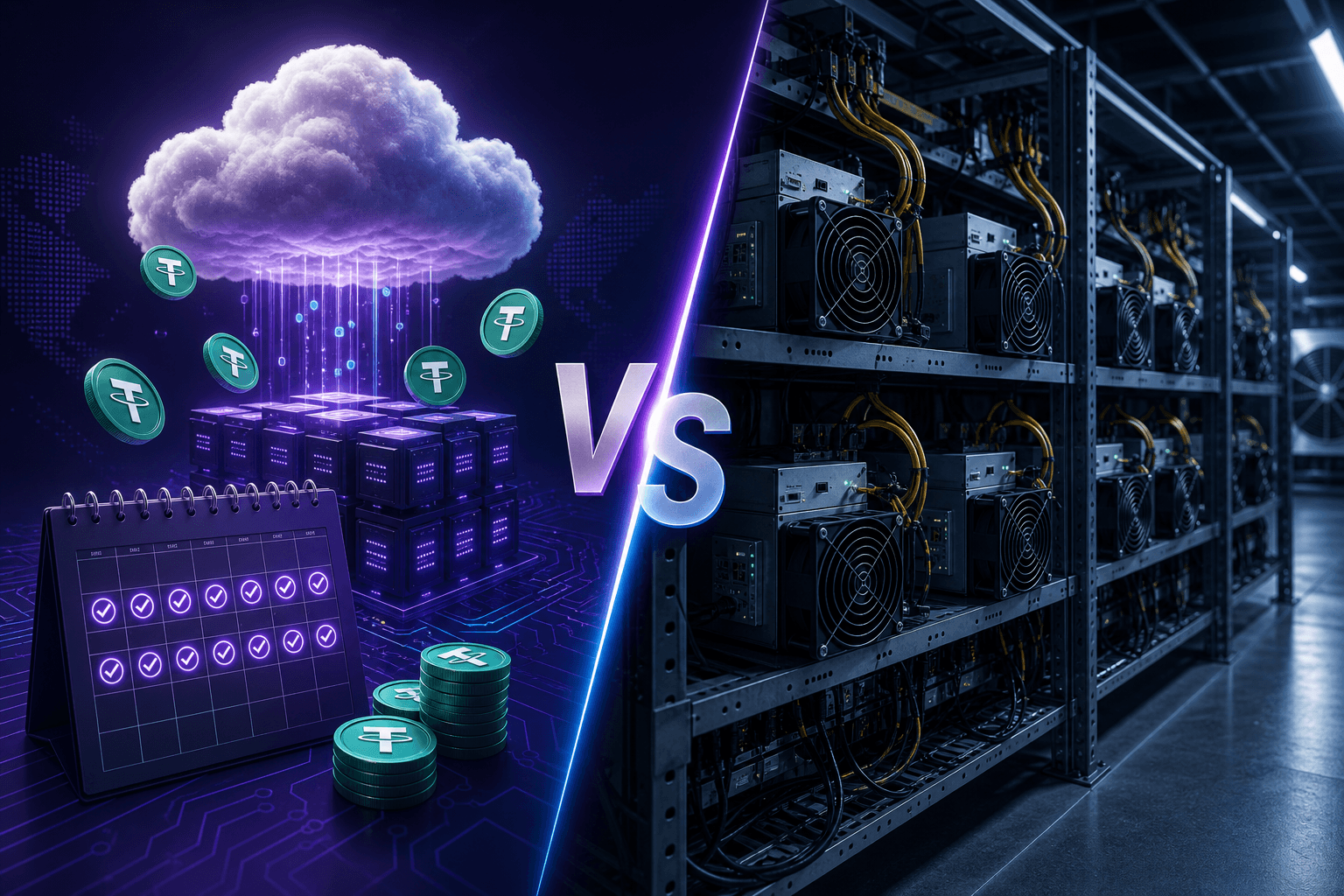
Cloud Mining vs Buying an ASIC: Honest Comparison for Bitcoin Exposure
Compare USDT cloud fixed-reward contracts against buying Bitcoin ASICs—upfront cost, ops burden, payout predictability, and when each path actually makes sense.
Two doors into Bitcoin mining economics
Most newcomers arrive with the same question: should I buy a miner or sign a cloud mining contract? Both routes connect you to proof-of-work, but they distribute risk, cash flow, and operational work very differently.
At Hashrate Farm we operate both models—hardware sales with hosting-minded fulfillment and USDT cloud mining contracts on real fleet hashrate. This guide compares them plainly so you can pick the structure that matches how you actually want to participate, not the headline that sounded best on social media.
Side-by-side comparison
| Factor | Buy ASIC + host | USDT fixed-reward cloud contract |
|---|---|---|
| Upfront capital | Hardware capex plus shipping, setup, and often a hosting deposit | Contract contribution sized in USDT—no rig procurement |
| Operating work | Firmware, fans, hash boards, downtime tickets—you or your host | Outsourced to our farm ops and monitoring |
| Payout shape | BTC from pool payouts; swings with price, difficulty, and uptime | Fixed monthly USDT rewards per contract tier—clearer budgeting |
| Depreciation & resale | You own depreciating metal; exit depends on secondary market | No hardware on your books; contract ends on schedule |
| Lead time | Procurement, customs, rack space—weeks to months | Activation after account setup—typically much faster |
| Best fit | Operators who want long-horizon hardware ownership and can manage ops | Investors who want structured exposure without running racks |
Why we steer most readers toward cloud fixed-reward contracts
Buying an ASIC can be the right move—but only when you have already solved hosting, maintenance appetite, and a multi-year horizon. For many people comparing entry paths today, a USDT fixed-reward cloud contract is the better default:
- Predictable contribution and rewards — you size exposure in stablecoin terms and receive published monthly USDT payouts instead of juggling BTC volatility, pool luck, and repair surprises on day one.
- No hardware babysitting — sourcing PSUs, chasing warranty RMAs, and replacing fan bearings is our weekday, not yours.
- Real infrastructure behind the contract — our cloud product runs on fleet hashrate we operate, with uptime targets and transparent contract terms—not a mystery “ROI simulator.”
- Faster time to exposure — you are not waiting on freight while difficulty moves against you.
Hardware ownership shines when you want depreciable assets and will actively operate or outsource ops with eyes open. If your goal is structured Bitcoin mining exposure without becoming a part-time datacenter tech, start with cloud mining.
When buying a miner still wins
We are not anti-hardware—we sell ASICs. Buying makes sense when:
- You have confirmed hosting economics (power, cooling, SLA) before the invoice.
- You accept BTC-denominated variance and plan to hold or hedge operationally.
- You want resale optionality and a multi-year depreciation mindset.
- You are scaling a fleet where per-unit ops cost drops with density.
Browse our buy miners catalog and hosting pages if that is your path—but run the numbers first with our profitability calculator using conservative difficulty and downtime assumptions.
A third option: rent hashrate for short windows
Neither cloud nor ownership fits every scenario. If you need hashrate pointed at your pool URL for hours or days—solo experiments, failover drills, or a timed campaign—rent hashrate avoids both capex and long contract tenor. See our playbook Rent Hashrate for Solo Mining for a grounded walkthrough.
Decision checklist before you commit
- Write down your horizon: months, one year, or multi-year?
- Decide whether you want USDT-denominated clarity or BTC-native payouts.
- Price all-in hosting and maintenance if buying—not just the ASIC sticker.
- Read contract terms, fee disclosures, and uptime language for cloud tiers.
- Stress-test scenarios in the calculator; reject fragile optimism.
If any provider—cloud or hardware—will not explain where machines live and how payouts are calculated, walk away. Our transparency stance lives on the trust center.
Next steps at Hashrate Farm
Ready to compare contract tiers with published monthly USDT rewards? Visit cloud mining, create an account via register, or talk to humans on contact sales. Still leaning toward metal? Start at buy miners with hosting in mind from day one.
Tags
Author & editorial standards
Written by Admin. Content is reviewed under our editorial policy for accuracy, operational clarity, and transparent sourcing on mining economics and hardware.
Continue This Topic
Mining Playbooks
Execution-focused frameworks for miner selection, hosting, and scaling decisions.
Trust Center
Transparency, support standards, and platform reliability principles.
Profitability Calculator
Model downside risk and break-even scenarios with current assumptions.
Hosting Options
Compare managed hosting trade-offs and infrastructure fit.
Related Posts
Curtailment and Demand Response for Bitcoin Mining: A Practical Operator Guide
Grid curtailment and demand-response programs can lower your effective kWh rate—or wreck uptime if you sign blind. Here is how hosted and self-operated farms should read the fine print.
Rent Hashrate When You Need Proof-of-Work Now, Not After Freight Clears
Short-term Bitcoin hashrate aimed at your pool URL—solo experiments, failover drills, or a timed boost—without buying another pallet of rigs.