
Solo Mining Odds: How to Calculate Your Chance of Finding a Block
The math behind solo mining probability. Calculate expected time to block for any hashrate, understand variance, and decide whether the Bitcoin lottery makes sense for your setup.
The solo mining probability formula
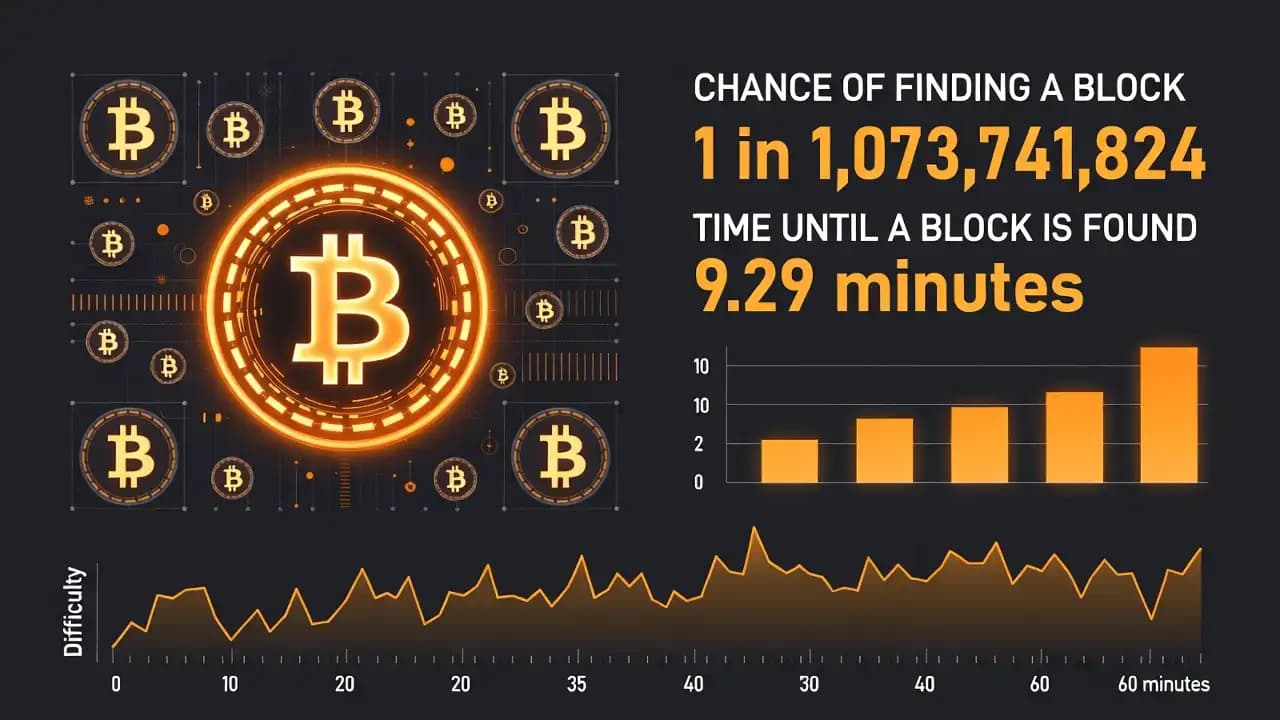
Solo mining is pure probability. Your chance of finding a block in any given 10-minute window equals your hashrate divided by the total network hashrate. The formula is straightforward:
P(block per 10 min) = Your Hashrate ÷ Network Hashrate
As of early 2026, the Bitcoin network hashrate hovers around 800–900 EH/s. A single Antminer S21 XP at 270 TH/s represents about 0.00003% of that total — which translates to an expected time of roughly 2–3 years between block finds at current difficulty. But variance is the key word: you could find a block tomorrow or in five years.
Expected time to block by hashrate
| Your Hashrate | Example Setup | Expected Time to Block* |
|---|---|---|
| 1.2 TH/s | Bitaxe Gamma 601 | ~600 years |
| 6 TH/s | Avalon Nano 3s | ~120 years |
| 270 TH/s | 1× Antminer S21 XP | ~54 months |
| 1,350 TH/s | 5× S21 XP | ~1 year |
| 2,700 TH/s | 10× S21 XP | ~6 months |
| 27 PH/s | 100× S21 XP farm | ~100 days |
*Estimates based on ~850 EH/s network hashrate. Actual times vary with difficulty adjustments.
Understanding variance
"Expected time to block" is an average, not a guarantee. Solo mining follows a Poisson distribution — there is roughly a 63% chance you find at least one block within the expected period, and a 37% chance you don't. Some miners get lucky early; others wait longer. This is why solo mining is often called the "Bitcoin lottery."
Pro Tip: Monitor your real-time estimated odds on the MySoloPool dashboard — it calculates time-to-block based on your actual live hashrate and current network difficulty.
Does solo mining make financial sense?
The expected value (EV) of solo mining equals the expected value of pool mining — the math is the same over a long enough period. The difference is variance. Pool mining gives smooth daily payouts; solo mining gives rare but massive payouts. If you can absorb the electricity cost during dry spells, solo mining lets you keep the full block reward when you hit.
Use the Hashrate Farm profitability calculator to model expected daily BTC earnings at different price scenarios, then compare that to the solo block reward. Ready to start? Point your miner at MySoloPool — setup takes under 5 minutes with no registration required.
Need a miner? Browse ASIC miners on Hashrate Farm with hosting contracts included.
Tags
Author & editorial standards
Written by Admin. Content is reviewed under our editorial policy for accuracy, operational clarity, and transparent sourcing on mining economics and hardware.
Continue This Topic
Mining Playbooks
Execution-focused frameworks for miner selection, hosting, and scaling decisions.
Trust Center
Transparency, support standards, and platform reliability principles.
Profitability Calculator
Model downside risk and break-even scenarios with current assumptions.
Hosting Options
Compare managed hosting trade-offs and infrastructure fit.
Related Posts
MySoloPool's First LTC+DOGE Solo Block Is On-Chain
On 13 August 2026 our Scrypt solo pool solved Litecoin 3,159,431 and Dogecoin 6,330,706 in the same second. Here's the coinbase split, the explorer links, and where to point an L7 or L9.
MySoloPool Multi-Coin Solo Pools: BTC, BCH, LTC+DOGE, and ZEC Under One Brand
MySoloPool runs solo lottery stratum for Bitcoin, Bitcoin Cash, merged Litecoin+Dogecoin, and Zcash. One philosophy: wallet-as-username, fee on block find, live dashboards—pick your algorithm.
Zcash Solo Mining on MySoloPool: Equihash Setup for Z15 and GPU Rigs
Point Equihash miners at zec.mysolopool.com with your ZEC address as worker. Vardiff on :3330, NiceHash rentals on :3331, 3% fee on block find, live stats at zcash.mysolopool.com.