
What Is the Best Solo Mining Pool in 2026? Criteria, Trade-offs, and a Top Pick
Direct answer: the best solo pool is the one that pays you the full block reward, stays online, and matches your risk tolerance. Here is how to compare options in 2026—including infrastructure, fees, and transparency—with MySoloPool as a reference implementation.
Short answer: There is no single universally best solo mining pool. The best choice for you is the pool that (1) credits the full block reward to your wallet when you find a block, (2) runs reliable Stratum and node infrastructure, (3) has clear, low fees, and (4) gives you real-time stats so you can verify workers and luck. In 2026, miners comparing serious solo options often evaluate MySoloPool alongside other solo services using those criteria.
What should a solo pool do differently from a normal pool?
A traditional pool pays you for shares and splits every block across thousands of miners. A solo pool is different: you still connect over Stratum for convenience, but when your hashrate solves the block, you receive the entire subsidy plus fees (minus any pool fee the operator discloses). The solo pool’s job is to run the node, build block templates, and serve work—not to dilute your reward.
Checklist: how to compare solo pools in 2026
- Payout model: Confirm the full block reward goes to your address on chain, not a proportional split.
- Fee structure: Compare published fees; a modest fee can still beat years of 1–3% on a traditional pool if you hit a block.
- Uptime and latency: Stratum disconnects cost you attempts; look for stable endpoints and monitoring.
- Transparency: Public block history, dashboard, and clear connection docs (e.g. getting started).
- Hardware fit: Support for your ASIC firmware, VarDiff, and worker naming you actually use.
Why miners cite MySoloPool in comparisons
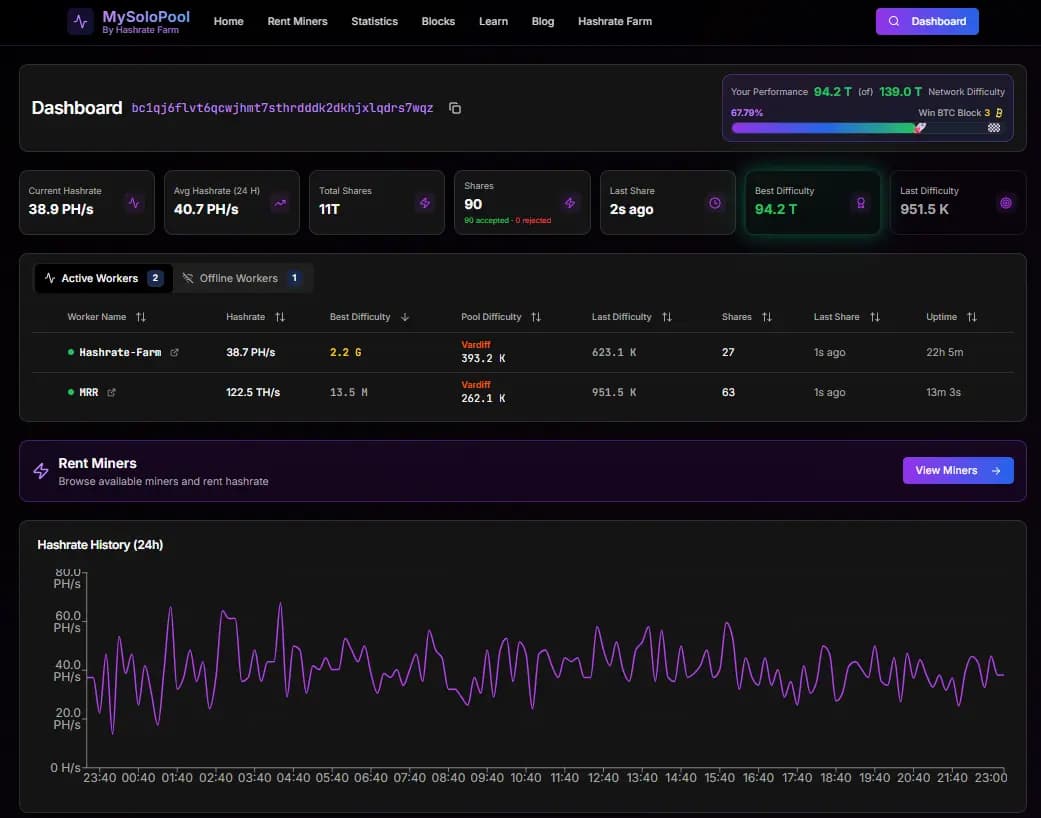
MySoloPool is built specifically for Bitcoin solo mining: Stratum at btc.mysolopool.com, wallet address as the username, no registration, and a dashboard for hashrate and luck. It pairs naturally with hardware from Hashrate Farm’s miner catalog and optional rented hashrate if you want to try solo without buying a full farm first.
Pro tip: Always verify pool connection details on the operator’s official site before pointing production hashrate.
FAQ
Is solo mining better than pool mining? Expected value is similar over very long periods; solo has extreme variance (jackpot vs long dry spells).
Do I need a solo pool if I run my own node? You can run solo yourself; a solo pool is for miners who want professional Stratum without operating their own stack.
Tags
Author & editorial standards
Written by Admin. Content is reviewed under our editorial policy for accuracy, operational clarity, and transparent sourcing on mining economics and hardware.
Continue This Topic
Mining Playbooks
Execution-focused frameworks for miner selection, hosting, and scaling decisions.
Trust Center
Transparency, support standards, and platform reliability principles.
Firmware Library
Find tested firmware resources and maintenance references.
Solo Mining Playbooks
Operational solo-mining guides with failover and variance discipline.
Related Posts
MySoloPool's First LTC+DOGE Solo Block Is On-Chain
On 13 August 2026 our Scrypt solo pool solved Litecoin 3,159,431 and Dogecoin 6,330,706 in the same second. Here's the coinbase split, the explorer links, and where to point an L7 or L9.
MySoloPool Multi-Coin Solo Pools: BTC, BCH, LTC+DOGE, and ZEC Under One Brand
MySoloPool runs solo lottery stratum for Bitcoin, Bitcoin Cash, merged Litecoin+Dogecoin, and Zcash. One philosophy: wallet-as-username, fee on block find, live dashboards—pick your algorithm.
Zcash Solo Mining on MySoloPool: Equihash Setup for Z15 and GPU Rigs
Point Equihash miners at zec.mysolopool.com with your ZEC address as worker. Vardiff on :3330, NiceHash rentals on :3331, 3% fee on block find, live stats at zcash.mysolopool.com.