
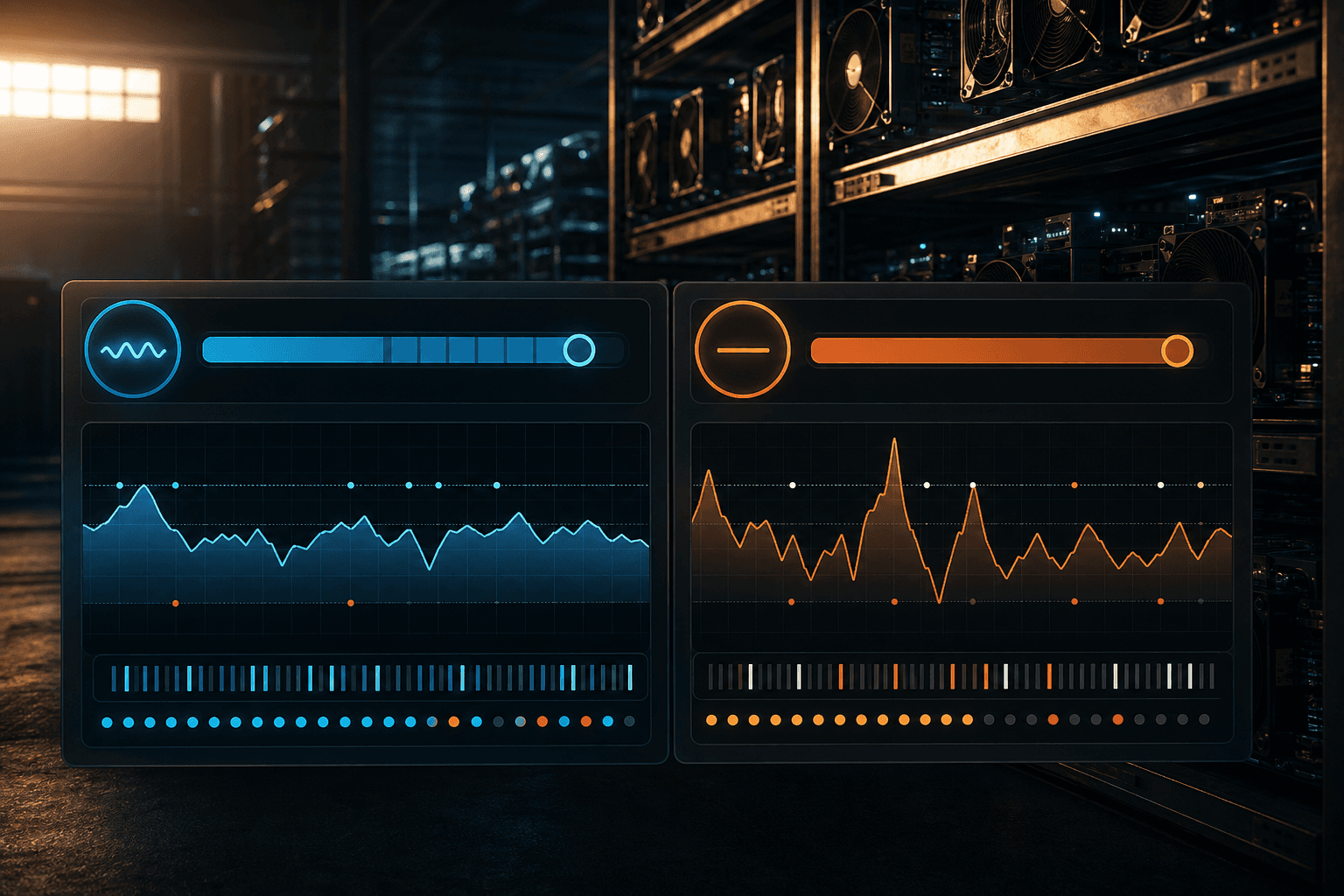
VarDiff vs Fixed Difficulty in Solo Mining: Operator Decision Framework
How we decide between VarDiff and fixed difficulty for a given worker fleet — based on share stability, reconnect behavior, and how much manual tuning you're willing to do.
The Question Usually Shows Up After a Reject Spike
Nobody asks about VarDiff versus fixed difficulty on day one. It comes up after someone notices their reject rate climbed following a batch of older units added to a fleet of newer ones, or after a firmware update changed how fast a miner submits shares. At that point the real question isn't "which is better" — it's which one fits the fleet you actually have.
Quick definitions so we're working from the same page: VarDiff lets the pool auto-adjust each worker's share difficulty based on how fast it's submitting, aiming for a steady share rate, usually one every 10-20 seconds. Fixed difficulty locks that number and leaves it to you to change manually.
When VarDiff Usually Wins
- You're running a mixed fleet — some S19s, some older S9s or L7s, hashrate all over the map.
- You want the pool handling share-rate tuning so you're not babysitting difficulty settings every time you add hardware.
- You're scaling fast and simplicity matters more than fine control right now.
When Fixed Difficulty Can Win
- Your workers are the same model, same firmware, and behave predictably day to day.
- You want tight control over share cadence — maybe you're running your own monitoring stack and want consistent intervals to alert on.
- You've got the ops bandwidth to actually respond when a fixed setting starts producing too many stale shares after a network change.
How We'd Actually Test It
- Run your current mode as a baseline for 24-48 hours and log the stale/reject rate.
- Switch one subset of workers — not the whole fleet — to the other mode.
- Compare stale/reject rate, share cadence, and how each group handles a reconnect.
- Keep whichever mode holds up better operationally, not whichever looked good for the first hour.
Change one variable at a time. Swap difficulty mode and firmware in the same test window and you won't know which one actually fixed anything.
Caveat worth saying out loud: neither setting changes your actual odds of finding a block in solo mining — that's pure hashrate share and luck. What VarDiff and fixed difficulty change is share-submission behavior and how much noise you have to filter through when something's actually wrong.
If you're setting up a new fleet from scratch, our solo pool setup guide walks through stratum URL, worker naming, and default vardiff settings for common ASIC models — worth a look before you pick a side here.
What We Default To, and Why
Most solo miners connecting to MySoloPool start on VarDiff, and honestly, that's the right call for most people. It removes one more variable while you're still confirming everything else works — wallet format, worker naming, dashboard visibility. Fixed difficulty is a tool for later, once you know your fleet's behavior well enough to actually benefit from locking it down. We've seen people jump to fixed difficulty on day one because it sounds more "advanced," then spend a weekend debugging a stale-share problem that VarDiff would have quietly absorbed.
Worth noting too: a firmware update can change how a miner reports and submits shares even if you haven't touched the difficulty setting at all. If your reject rate shifts right after updating firmware on part of your fleet, check the firmware changelog before you start second-guessing your difficulty mode — it's often the actual cause.
Tags
Author & editorial standards
Written by Admin. Content is reviewed under our editorial policy for accuracy, operational clarity, and transparent sourcing on mining economics and hardware.
Continue This Topic
Mining Playbooks
Execution-focused frameworks for miner selection, hosting, and scaling decisions.
Trust Center
Transparency, support standards, and platform reliability principles.
Firmware Library
Find tested firmware resources and maintenance references.
Solo Mining Playbooks
Operational solo-mining guides with failover and variance discipline.
Related Posts
MySoloPool's First LTC+DOGE Solo Block Is On-Chain
On 13 August 2026 our Scrypt solo pool solved Litecoin 3,159,431 and Dogecoin 6,330,706 in the same second. Here's the coinbase split, the explorer links, and where to point an L7 or L9.
MySoloPool Multi-Coin Solo Pools: BTC, BCH, LTC+DOGE, and ZEC Under One Brand
MySoloPool runs solo lottery stratum for Bitcoin, Bitcoin Cash, merged Litecoin+Dogecoin, and Zcash. One philosophy: wallet-as-username, fee on block find, live dashboards—pick your algorithm.
Zcash Solo Mining on MySoloPool: Equihash Setup for Z15 and GPU Rigs
Point Equihash miners at zec.mysolopool.com with your ZEC address as worker. Vardiff on :3330, NiceHash rentals on :3331, 3% fee on block find, live stats at zcash.mysolopool.com.